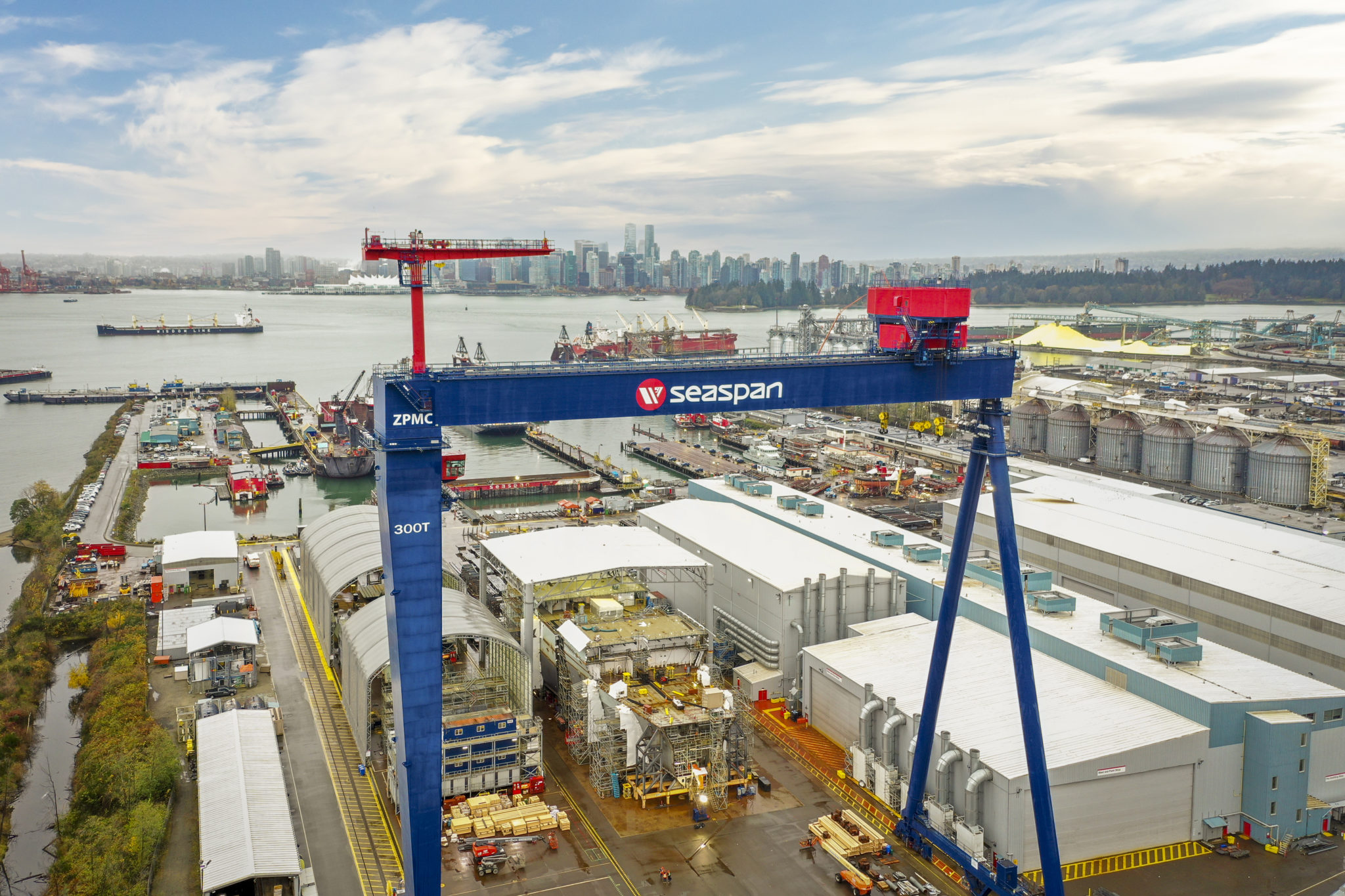
Seaspan Shipyards  has been awarded a significant contract to construct a new heavy polar icebreaker for the Canadian Coast Guard (CCG). This marks the first polar icebreaker to be built in Canada in over 60 years, a project scheduled to begin in April 2025 at Seaspan's Vancouver Shipyards in North Vancouver, British Columbia. The initiative is a pivotal element of Canada’s National Shipbuilding Strategy (NSS), aiming to enhance the fleet's capabilities with a state-of-the-art design. The vessel will join a select group of Polar Class 2 ships, designed to operate in some of the harshest environments with an ability to function at temperatures as low as -50°C. With dimensions of 158 meters in length and 28 meters in width, the new icebreaker will feature advanced technological capabilities. These include over 40MW of installed power and an ice-classed azimuthing propulsion system. In addition, it will boast comprehensive research facilities, such as scientific laboratories, a moon pool for deploying equipment, and helicopter facilities, alongside potential for future use of remotely piloted aircraft systems. Economic implications of this project are substantial, with over 1,000 local shipbuilders involved and participation from more than 800 Canadian companies in the supply chain. According to Deloitte's analysis, Seaspan has already contributed $5.7 billion to Canada’s GDP from 2012 to 2023, sustaining over 7,000 jobs annually. This venture will be the seventh ship designed and built by Seaspan under the NSS and the fifth Polar Class vessel for the CCG. The design completion took place in 2024 in collaboration with experienced Finnish companies in Arctic vessel design. With an investment exceeding CAD $200M in shipyard upgrades, Seaspan positions itself as a leader in North America's shipbuilding industry. The company's previous work includes three offshore fisheries science vessels currently in service for the CCG, with another oceanographic science vessel nearing completion. This contract emphasizes Canada’s dedication to building domestic shipbuilding proficiency and advancing maritime capabilities. The new icebreaker will be vital for scientific research, environmental protection, and ensuring national security in the challenging Arctic regions.
Seaspan Shipyards Secures Contract for Canadian Polar Icebreaker
 Seaspan Shipyards
COMPANY_GROUP
Newbuild
Seaspan Shipyards
COMPANY_GROUP
Newbuild
Ella Trusteddocks
Topics
Connected to This Story
Free weekly digest
This week's ship orders & deliveries — every Friday
New contracts, launches and shipyard news in one email. No account needed, unsubscribe anytime.
More Shipbuilding News
View all →
Yangzijiang Maritime Orders Four Kamsarmax Bulkers from WE
Yangzijiang Maritime has signed a contract with Watts Energy & Engineering (WE) for the construction of four 82,000 DWT…
Oct 12, 2026
Newbuilding Contracts — Week 41/2026
181 newbuilding orders across 9 segments were recorded in the New-Ships orderbook in week 41/2026 (05 October–11…
Oct 12, 2026
Iskra Shipyard and HD Hyundai Heavy Industries Sign Cooperation Deal
Croatia's Iskra Shipyard and South Korea's HD Hyundai Heavy Industries (HHI) have signed a cooperation agreement…
Oct 11, 2026
Hengli Secures 11 VLAC Orders in a Single Week
Hengli Heavy Industries has signed contracts for 11 very large ammonia carriers (VLACs) within one week, spanning…
Oct 11, 2026